
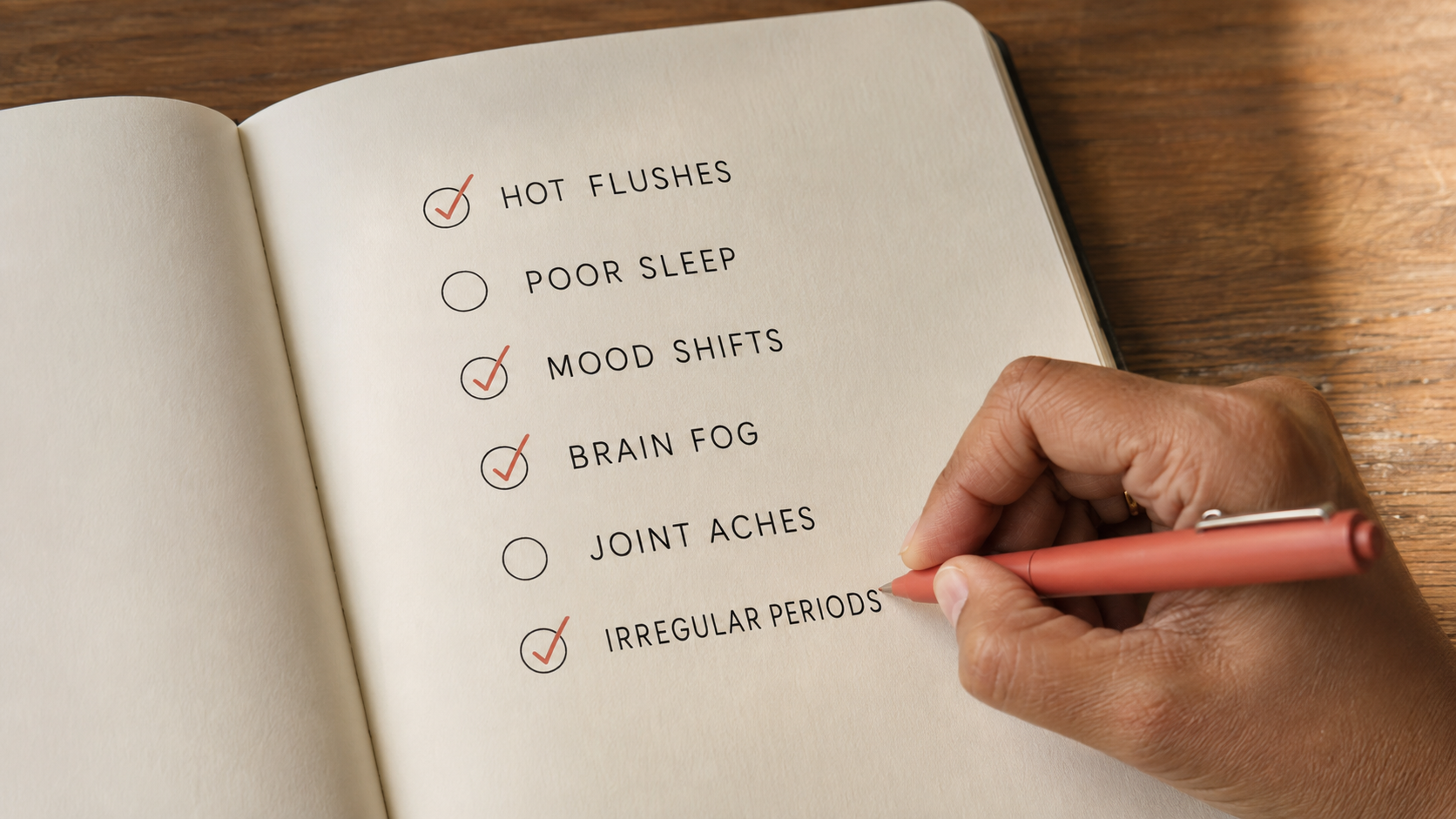
Recognising the Signs: What Menopause Actually Feels Like
Many women spend months, sometimes years, experiencing symptoms they cannot quite explain. Sleep that suddenly feels unreliable. A flash of heat that comes from nowhere. A cycle that has shifted from its familiar pattern. Moods that feel harder to manage than usual. These experiences are real and disruptive, yet they are frequently attributed to stress, ageing in general, or simply being busy. For a significant number of women, they are the early signs of the menopausal transition.
Recognising menopause symptoms for what they are is the first step towards responding to them well. This article covers the full range of symptoms associated with the menopausal transition, organised by the body systems they affect, so that women can connect what they are experiencing to what is happening biologically.
Why Menopause Produces Such a Wide Range of Symptoms
Oestrogen receptors are found throughout the body: in the brain, bones, heart, skin, gut, bladder, and more. This is why declining oestrogen during the menopausal transition produces effects that go far beyond the reproductive system. When oestrogen levels begin to fluctuate and fall, those changes ripple across multiple body systems simultaneously, which is why menopause symptoms can feel so varied and unconnected at first glance.
Understanding this helps explain why two women can describe their menopause experiences in completely different terms. One may feel defined by sleep disruption and brain fog; another by joint pain and low mood; another primarily by changes in her cycle. All of these are legitimate expressions of the same underlying hormonal shift.
The Most Commonly Reported Symptoms
Changes to the menstrual cycle are typically the earliest and most consistent sign that the menopausal transition has begun. Periods may become irregular in timing, arriving earlier or later than expected. Flow may change, becoming heavier, lighter, shorter, or longer. Some cycles may be skipped entirely. These changes reflect the increasingly erratic hormonal signalling between the brain and the ovaries.
Vasomotor symptoms, which include hot flushes and night sweats, are the most widely recognised symptoms of menopause and affect a substantial proportion of women during the transition. A hot flush is a sudden sensation of warmth, typically in the face, neck, and chest, often accompanied by flushing of the skin and sometimes followed by sweating and a feeling of chilling. Night sweats are the same physiological event occurring during sleep, frequently disrupting rest. Studies suggest that between 60 and 80 percent of women experience vasomotor symptoms during the menopausal transition, though the intensity and frequency vary considerably.
Sleep disturbance is among the most frequently reported and most impactful symptoms. Difficulty falling asleep, waking in the night, and early morning waking are all common. While night sweats contribute to disrupted sleep, hormonal changes also affect sleep architecture directly, independently of temperature-related waking.
Mood and psychological symptoms are real and common, though often overlooked or attributed to external life stressors. Increased anxiety, low mood, irritability, and a reduced sense of emotional resilience are all associated with the hormonal fluctuations of perimenopause. This is not simply a psychological reaction to change; oestrogen has a direct influence on neurotransmitters including serotonin and dopamine, which regulate mood and emotional wellbeing.
Cognitive changes, sometimes described as brain fog, include difficulty concentrating, word-finding difficulties, and short-term memory lapses. These symptoms are widely reported and can be particularly distressing for women who are professionally active. Research suggests these are related to hormonal fluctuation rather than permanent cognitive decline, and they often improve after the transition stabilises.
Genitourinary symptoms include vaginal dryness, discomfort during sexual activity, increased urinary frequency or urgency, and a greater susceptibility to urinary tract infections. These arise because the tissues of the vagina, urethra, and bladder are sensitive to oestrogen, and their thinning and drying in a lower-oestrogen environment can cause persistent discomfort.
Physical symptoms such as joint aches, headaches, skin changes including dryness and loss of elasticity, hair thinning, and changes in body composition including a tendency towards weight gain around the abdomen are also associated with the menopausal transition, though the evidence base is stronger for some than others.
Did You Know? Research published in the journal Menopause involving Indian women found that joint pain and body aches were among the most commonly reported symptoms, alongside hot flushes and sleep disruption, suggesting that musculoskeletal symptoms may be particularly prominent in the Indian context.
Connecting Symptoms to Your Own Experience
One of the most common challenges women face is not recognising their symptoms as menopause-related in the first place. A woman in her early forties experiencing anxiety, fatigue, and irregular periods may seek separate consultations for each concern, not realising they share a common hormonal cause. This fragmentation can lead to years of unexplained symptoms and unnecessary worry.
In India, where menopause is still not widely discussed across all communities, this gap between experience and recognition is particularly common. Women may normalise their symptoms, attribute them to the demands of family life or the heat of the climate, or feel reluctant to raise them with a doctor. Cultural attitudes around ageing and women’s health can add an additional layer of silence.
This is why naming symptoms matters. When a woman can identify what she is experiencing as part of the menopausal transition, she gains the ability to seek appropriate information, track patterns over time, and have more productive conversations with healthcare providers. Symptom tracking, in particular, is a powerful tool: noting when symptoms occur, how frequently, and what seems to trigger or ease them builds a picture that memory alone cannot hold.
It is also worth remembering that the absence of certain well-known symptoms does not mean menopause is not underway. Not every woman experiences hot flushes. Not everyone notices dramatic mood changes. The transition manifests differently for each woman, and an experience that looks nothing like what a friend or relative described is still entirely valid.
Key Takeaways
- Menopause symptoms are wide-ranging because oestrogen receptors are found throughout the body, not just in the reproductive system.
- The most commonly reported symptoms include menstrual irregularity, hot flushes, night sweats, sleep disruption, mood changes, cognitive changes, and genitourinary symptoms.
- Joint pain and musculoskeletal symptoms appear to be particularly prominent among Indian women.
- Many women do not initially connect their symptoms to the menopausal transition, leading to delayed recognition and support.
- Symptom tracking helps women identify patterns and have more informed conversations with their healthcare providers.
At Emvera, we believe every woman deserves the knowledge and support to better understand, accept, and embrace menopause as a natural life transition. Through personalised symptom tracking, evidence-based education, a supportive community, and a curated marketplace of trusted wellness products, Emvera helps women navigate their menopause journey with greater clarity, control, and confidence.
Knowing which symptoms are associated with menopause is important. Understanding why those symptoms vary so much between women is equally so. The next article, Symptom Variability, explores the factors that determine why one woman’s transition feels mild while another’s is significantly disruptive, and what influences the intensity, duration, and pattern of symptoms.
References
- Santoro N, Roeca C, Peters BA, Neal-Perry G. The menopause transition: signs, symptoms, and management options. Journal of Clinical Endocrinology and Metabolism. 2021;106(1):1-15.
- Avis NE, et al. Duration of menopausal vasomotor symptoms over the menopause transition. JAMA Internal Medicine. 2015;175(4):531-539.
- Sharma S, Tandon VR, Mahajan A. Menopausal symptoms in urban women. JK Science. 2007;9(1):13-17.
- The North American Menopause Society (NAMS). Menopause Practice: A Clinician’s Guide. 5th ed. Pepper Pike, OH: NAMS; 2014.