
The Chemical Messengers Behind Your Menopause Journey
If you have ever wondered why menopause brings such wide-ranging changes, from sleep disturbances to mood shifts to changes in your skin, the answer lies in your hormones. These chemical messengers do far more than regulate your menstrual cycle. They influence your brain, your bones, your heart, and much more. When their levels begin to shift as you approach menopause, the effects ripple across your entire body.
This article introduces the key hormones involved in reproductive aging, explains what each one does, and helps you understand why their changing levels matter so much during the menopausal transition.
The Four Hormones You Need to Know
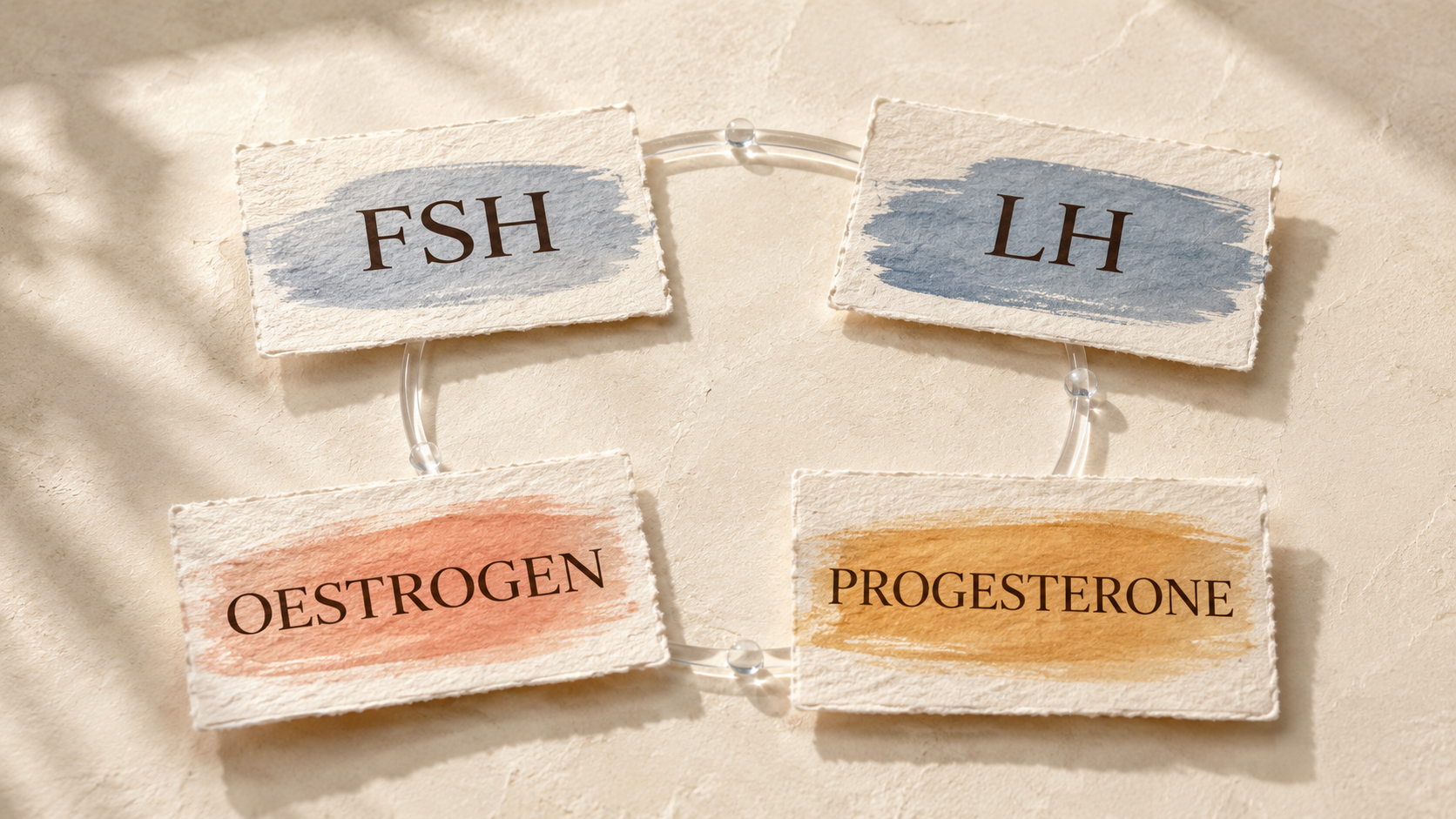
The menstrual cycle and the transition through menopause are governed by a coordinated system involving four main hormones. Two are produced in the ovaries, and two are produced in the brain. Together, they form a feedback loop that regulates ovulation, menstruation, and fertility throughout a woman’s reproductive life.
Oestrogen is the hormone most commonly associated with menopause, and for good reason. Produced primarily by the ovaries, oestrogen plays a central role in female sexual development and reproductive function. But its influence extends well beyond reproduction. Oestrogen helps maintain bone density, supports cardiovascular health, regulates body temperature, keeps vaginal tissue healthy, and has a significant effect on mood and cognitive function. The body actually produces three forms of oestrogen: oestradiol (the most potent form, dominant during reproductive years), oestrone (more prominent after menopause), and oestriol (produced mainly during pregnancy).
Progesterone is produced by the ovaries after ovulation, specifically by the temporary gland that forms once an egg is released. Its primary role is to prepare the uterine lining for a potential pregnancy. When pregnancy does not occur, progesterone levels drop, triggering menstruation. Beyond the uterus, progesterone has calming effects on the nervous system and supports sleep. When ovulation becomes irregular during perimenopause, progesterone production also becomes erratic, which is one reason sleep disturbances are so common during this time.
Follicle-stimulating hormone (FSH) is released by a small gland at the base of the brain called the pituitary gland. FSH does exactly what its name suggests: it stimulates the ovarian follicles (the fluid-filled sacs that contain eggs) to grow and mature each cycle. As ovarian reserve declines with age, the ovaries respond less readily to FSH, so the brain compensates by releasing more of it. Rising FSH levels are a clinical indicator that the menopausal transition is underway.
Luteinising hormone (LH) is also released by the pituitary gland. A sharp surge in LH triggers ovulation, the release of a mature egg from the follicle. Like FSH, LH levels rise as the ovaries become less responsive to hormonal signals.
How the System Changes Over Time
During the reproductive years, oestrogen, progesterone, FSH, and LH work in a beautifully timed rhythm. FSH rises to stimulate follicle growth; oestrogen climbs as the follicle matures; an LH surge triggers ovulation; progesterone rises to prepare the uterus; and if pregnancy does not occur, both oestrogen and progesterone fall, and the cycle begins again.
As a woman moves into her late thirties and forties, the ovaries contain fewer follicles and respond less predictably to FSH. Oestrogen production becomes more variable, rising and falling irregularly rather than following a smooth monthly pattern. Progesterone output declines because fewer ovulations mean less of the temporary gland that produces it. Meanwhile, the brain keeps sending stronger signals, which is why FSH and LH levels rise noticeably during perimenopause.
Did You Know? A blood test measuring FSH is sometimes used to assess whether a woman may be approaching menopause. An FSH level consistently above 30 to 40 IU/L, alongside irregular periods, is generally considered consistent with the menopausal transition, though results should always be interpreted alongside symptoms and clinical history.
What Shifting Hormones Actually Feel Like
The hormonal changes described above are not just numbers on a blood test. They translate into real, everyday experiences. The irregular and sometimes dramatic swings in oestrogen are closely linked to hot flushes and night sweats, two of the most widely reported symptoms of perimenopause. Declining progesterone affects sleep quality and can contribute to feelings of anxiety or irritability. Lower oestrogen over time affects bone density, skin moisture, and vaginal comfort.
A common misconception is that oestrogen simply “runs out” at menopause. In reality, oestrogen does not disappear entirely. After menopause, the ovaries produce very little oestrogen, but the body continues to make small amounts through the adrenal glands and body fat, a process called peripheral conversion. The dramatic shift is in oestradiol, which falls significantly, while oestrone becomes the dominant form.
For Indian women, it is worth noting that symptom experiences vary widely. Some women report relatively mild transitions, while others find the hormonal fluctuations significantly disruptive. Factors including body composition, stress levels, diet, and overall health all influence how hormonal changes are experienced, and there is no single “normal” experience.
Understanding your hormones also helps you have more informed conversations with your doctor, whether you are discussing irregular periods, mood changes, bone health, or potential treatment options.
Key Takeaways
- Four key hormones, oestrogen, progesterone, FSH, and LH, govern the reproductive cycle and change significantly during the menopausal transition.
- Oestrogen’s influence extends far beyond reproduction, affecting bones, the heart, the brain, mood, sleep, and skin.
- Declining ovarian response causes FSH and LH levels to rise, while oestrogen and progesterone levels become irregular and eventually fall.
- Oestrogen does not disappear at menopause; it shifts form, with oestradiol declining and oestrone becoming the primary type.
- Hormonal changes are the underlying cause of most menopause symptoms, and understanding them helps women make sense of their experiences.
At Emvera, we believe every woman deserves the knowledge and support to better understand, accept, and embrace menopause as a natural life transition. Through personalised symptom tracking, evidence-based education, a supportive community, and a curated marketplace of trusted wellness products, Emvera helps women navigate their menopause journey with greater clarity, control, and confidence.
With a solid understanding of the hormones involved in reproductive aging, you are now ready to make sense of the language used to describe the different stages of the transition. The next article, Menopause Terminology, clarifies the often-confused terms: perimenopause, menopause, and postmenopause, and explains exactly what each stage means and when it begins.
References
- Santoro N, Roeca C, Peters BA, Neal-Perry G. The menopause transition: signs, symptoms, and management options. Journal of Clinical Endocrinology and Metabolism. 2021;106(1):1-15.
- The North American Menopause Society (NAMS). Menopause Practice: A Clinician’s Guide. 5th ed. Pepper Pike, OH: NAMS; 2014.
- Harlow SD, et al. Executive summary of the Stages of Reproductive Aging Workshop + 10. Climacteric.2012;15(2):105-114.
- Ahuja M. Age of menopause and determinants of menopause age: A PAN India survey by IMS. Journal of Mid-life Health. 2016;7(3):126-131.
- Shifren JL, Gass MLS; NAMS Recommendations for Clinical Care of Midlife Women Working Group. The North American Menopause Society recommendations for clinical care of midlife women. Menopause.2014;21(10):1038-1062.