
When Menopause Arrives Before You Expected It
Most conversations about menopause assume it arrives in the mid-to-late forties or beyond. But for some women, the transition begins significantly earlier, in the thirties, or even in the twenties. When this happens, it brings not just the physical changes of menopause itself, but a set of unique challenges: the shock of an unexpected timeline, potential implications for fertility, and longer-term health considerations that do not apply to women who reach menopause at a typical age.
Early menopause is more common than many women realise, and understanding it is important whether you are experiencing it yourself, concerned about your risk, or simply building a complete picture of how menopause can unfold. This article explains what early menopause is, what causes it, and what it means for health and everyday life.
Defining Early Menopause and Where It Sits on the Spectrum
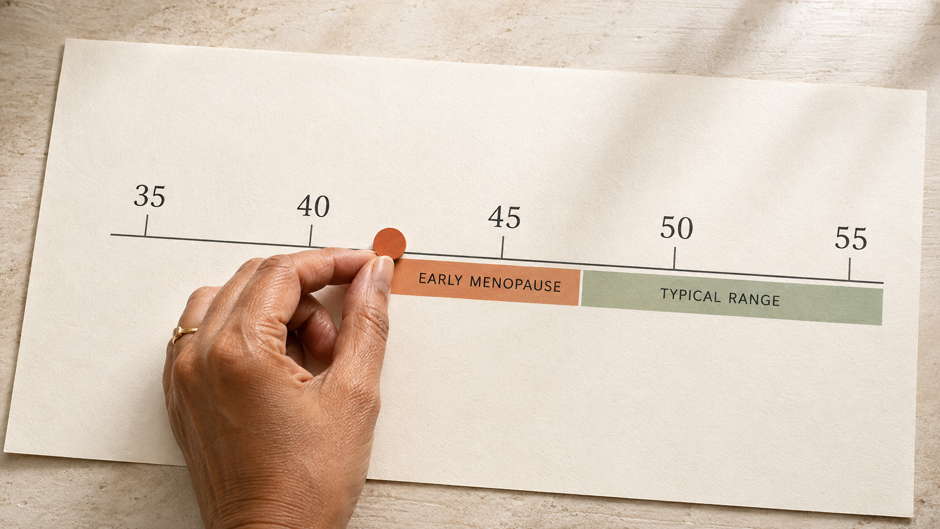
The term “early menopause” refers to menopause that occurs between the ages of 40 and 45. This is distinct from premature menopause, which is confirmed before the age of 40, and from the related but separate condition known as premature ovarian insufficiency (POI), which will be explored in the next article. The distinction matters because the causes, implications, and management needs differ between these categories.
Early menopause affects an estimated 5 to 10 percent of women globally. For Indian women, where the average age of natural menopause is already earlier than the global average at around 46 to 47 years, the boundary between “early” and “typical” menopause is somewhat narrower. A woman reaching menopause at 44 in India is closer to the national average than the same woman would be in a Western population, yet she may still benefit from the same awareness and health monitoring that applies to early menopause more broadly.
What Causes Early Menopause
Early menopause can arise from natural biological factors or from medical interventions, and the distinction shapes how it is experienced and managed.
Natural early menopause follows the same biological process as menopause at a typical age: gradual decline in ovarian reserve, increasingly irregular periods, and eventual cessation of menstruation. The difference is simply that this process completes ahead of the population average. Genetics is the strongest driver. Women whose mothers or sisters experienced early menopause are significantly more likely to do so themselves. Certain chromosomal variations and autoimmune conditions can also accelerate ovarian aging in ways that lead to earlier menopause.
Lifestyle factors play a supporting role. Smoking is associated with earlier menopause by one to two years on average, a finding that is consistent across multiple populations including Indian studies. Significant nutritional deficiency over time has also been linked to earlier ovarian decline in some research, a consideration that is particularly relevant in populations where chronic undernutrition affects a meaningful proportion of women.
Medically induced early menopause occurs when ovarian function is disrupted or ended by a medical procedure or treatment. Bilateral oophorectomy, the surgical removal of both ovaries, causes immediate menopause regardless of age. Chemotherapy and pelvic radiation, used in the treatment of cancer, can damage ovarian tissue and trigger early menopause, though the effect depends on the type and dose of treatment. In some women, chemotherapy-related menopause is temporary and ovarian function recovers; in others, the effect is permanent.
Did You Know? Research suggests that women who smoke reach menopause approximately one to two years earlier than non-smokers, making smoking one of the few directly modifiable risk factors for early menopause timing.
How Early Menopause Differs from Menopause at a Typical Age
The symptoms of early menopause are broadly similar to those of menopause at a typical age: irregular and then absent periods, hot flushes, sleep disruption, mood changes, vaginal dryness, and cognitive changes. However, early menopause carries additional considerations that make it clinically distinct.
The most significant is the duration of oestrogen deficiency. A woman who reaches menopause at 43 will spend substantially more years in a low-oestrogen state than a woman who reaches menopause at 51. Since oestrogen protects bone density and cardiovascular health, a longer period of oestrogen deficiency increases the cumulative risk of osteoporosis and heart disease. This is why medical guidelines generally recommend that women with early menopause consider hormone therapy to bridge the gap to the average age of natural menopause, unless there is a specific reason not to.
Fertility implications are another important dimension. A woman in her early forties who experiences irregular periods may not initially suspect that early menopause is the cause, particularly if she is still hoping to conceive. Early menopause can close the window for natural conception, making timely diagnosis important for women who wish to explore their options.
Emotionally, early menopause can carry a particular weight. Reaching this transition earlier than peers, possibly while managing young children or an active career, and without the social context that comes with menopause at a more expected age, can feel isolating. These emotional dimensions are real and deserve acknowledgement alongside the physical ones.
Living with Early Menopause: Practical Considerations
For women experiencing early menopause, the practical priorities centre on three areas: confirmation, health monitoring, and support.
Confirmation matters because irregular periods in the early forties can have multiple causes, and early menopause is just one of them. Thyroid conditions, stress-related cycle changes, and other hormonal factors can produce similar patterns. A conversation with a healthcare provider, including relevant blood tests such as FSH levels, helps clarify what is happening and opens the door to appropriate management.
Health monitoring becomes especially important given the longer duration of oestrogen deficiency. Bone density assessment and cardiovascular risk review are recommended for women with confirmed early menopause. In India, where both calcium intake and vitamin D levels are often below optimal even in the general population, these considerations take on additional relevance. Women with early menopause may benefit from discussing supplementation and dietary strategies with their doctor.
The question of hormone therapy, including its potential benefits and any individual considerations, is worth raising with a healthcare provider. For most women with early menopause and no contraindications, hormone therapy is considered beneficial for protecting long-term bone and cardiovascular health, at least until the average age of natural menopause.
Finally, emotional support matters too. Connecting with others who have experienced early menopause, whether through a community platform, a healthcare provider, or trusted relationships, can ease the sense of navigating an unexpected path alone.
Key Takeaways
- Early menopause is defined as menopause occurring between the ages of 40 and 45, and affects an estimated 5 to 10 percent of women globally.
- Causes include genetic factors, autoimmune conditions, smoking, nutritional deficiency, and medical interventions such as surgery, chemotherapy, or radiation.
- The primary health concern with early menopause is a longer duration of low oestrogen, which increases the cumulative risk of osteoporosis and cardiovascular disease.
- Timely diagnosis is important for women who wish to explore fertility options and for those who need to begin appropriate health monitoring early.
- Hormone therapy is generally recommended for women with early menopause to protect long-term health, subject to individual clinical assessment.
At Emvera, we believe every woman deserves the knowledge and support to better understand, accept, and embrace menopause as a natural life transition. Through personalised symptom tracking, evidence-based education, a supportive community, and a curated marketplace of trusted wellness products, Emvera helps women navigate their menopause journey with greater clarity, control, and confidence.
For some women, the ovaries stop functioning normally well before the age of 40, in a condition that is related to but distinct from early menopause. The next article, Premature Ovarian Insufficiency (POI), explores this condition in depth: what it means, how it differs from early menopause, how it is diagnosed, and what it means for fertility, health, and long-term wellbeing.
References
- Coulam CB, Adamson SC, Annegers JF. Incidence of premature ovarian failure. Obstetrics and Gynecology.1986;67(4):604-606.
- Ahuja M. Age of menopause and determinants of menopause age: A PAN India survey by IMS. Journal of Mid-life Health. 2016;7(3):126-131.
- Pokoradi AJ, Iversen L, Hannaford PC. Factors associated with age at onset of menopause in a cohort of UK women. American Journal of Obstetrics and Gynecology. 2011;205(1):34.e1-34.e13.
- The North American Menopause Society (NAMS). Menopause Practice: A Clinician’s Guide. 5th ed. Pepper Pike, OH: NAMS; 2014.
- Shelling AN. Premature ovarian failure. Reproduction. 2010;140(5):633-641.