
When the Ovaries Stop Working Ahead of Schedule
For most women, menopause is a gradual transition unfolding across the mid-to-late forties. But for roughly 1 in 100 women, the ovaries stop functioning normally well before the age of 40, sometimes even in the twenties or early thirties. This condition, called premature ovarian insufficiency, is distinct from early menopause and carries its own set of causes, diagnostic considerations, and implications.
Because it occurs at an age when menopause is rarely on a woman’s radar, premature ovarian insufficiency is often confusing, frightening, and difficult to get diagnosed quickly. This article explains what the condition is, why it happens, how it is identified, and what it means for fertility and long-term health.
What Premature Ovarian Insufficiency Actually Means
Premature ovarian insufficiency, commonly abbreviated as POI, occurs when the ovaries stop functioning normally before the age of 40. The word “insufficiency” is used deliberately, rather than “failure,” because ovarian function in POI is not always completely and permanently absent. Unlike natural menopause, where ovarian function ends in a predictable, gradual way, POI can be intermittent. Some women with POI experience occasional, unpredictable ovulation and even spontaneous pregnancy, which is one of the most important distinctions between POI and confirmed menopause.
POI affects approximately 1 percent of women by age 40, and about 1 in 1,000 women by age 30. While this makes it relatively uncommon, it is far from rare, and many women with the condition go undiagnosed or misdiagnosed for months or years, often because the symptoms, irregular or absent periods, can be mistaken for stress, polycystic ovary syndrome, thyroid dysfunction, or other conditions more commonly associated with younger women.
What Causes POI
In a substantial proportion of cases, no clear cause is identified, and the condition is classified as idiopathic, meaning the cause is unknown. Where a cause is identified, several categories emerge.
Genetic factors account for a meaningful share of POI cases. Chromosomal conditions such as Turner syndrome and Fragile X premutation are among the most well-documented genetic causes. Family history also plays a role: women with a mother or sister who experienced POI are at increased risk themselves.
Autoimmune conditions are another recognised cause. In autoimmune POI, the body’s immune system mistakenly targets ovarian tissue, impairing its function. This is sometimes associated with other autoimmune conditions, including thyroid disease and adrenal insufficiency, which is why testing for related autoimmune markers is often part of a thorough diagnostic workup.
Medical treatments, particularly chemotherapy and radiation therapy used in cancer treatment, can damage ovarian tissue and lead to POI. The risk depends on the type of treatment, the dose, and the woman’s age at the time of treatment. Surgical procedures involving the ovaries, even when both ovaries are not removed, can sometimes affect blood supply and function in ways that contribute to POI.
Infections are a less common but documented cause in some cases, though this represents a smaller proportion of overall diagnoses.
Did You Know? Unlike natural menopause, where ovarian function is consistently and permanently absent once confirmed, an estimated 5 to 10 percent of women with POI experience spontaneous, unpredictable return of ovarian function at some point, including occasional spontaneous pregnancy. This is one of the most important distinctions between POI and menopause at a typical age.
How POI Is Identified
The diagnostic pathway for POI typically begins with a woman under 40 experiencing irregular or absent periods for several consecutive months, often alongside menopause-like symptoms such as hot flushes, night sweats, or vaginal dryness. Because these symptoms are unexpected at this age, they are frequently attributed to other causes initially, which can delay diagnosis.
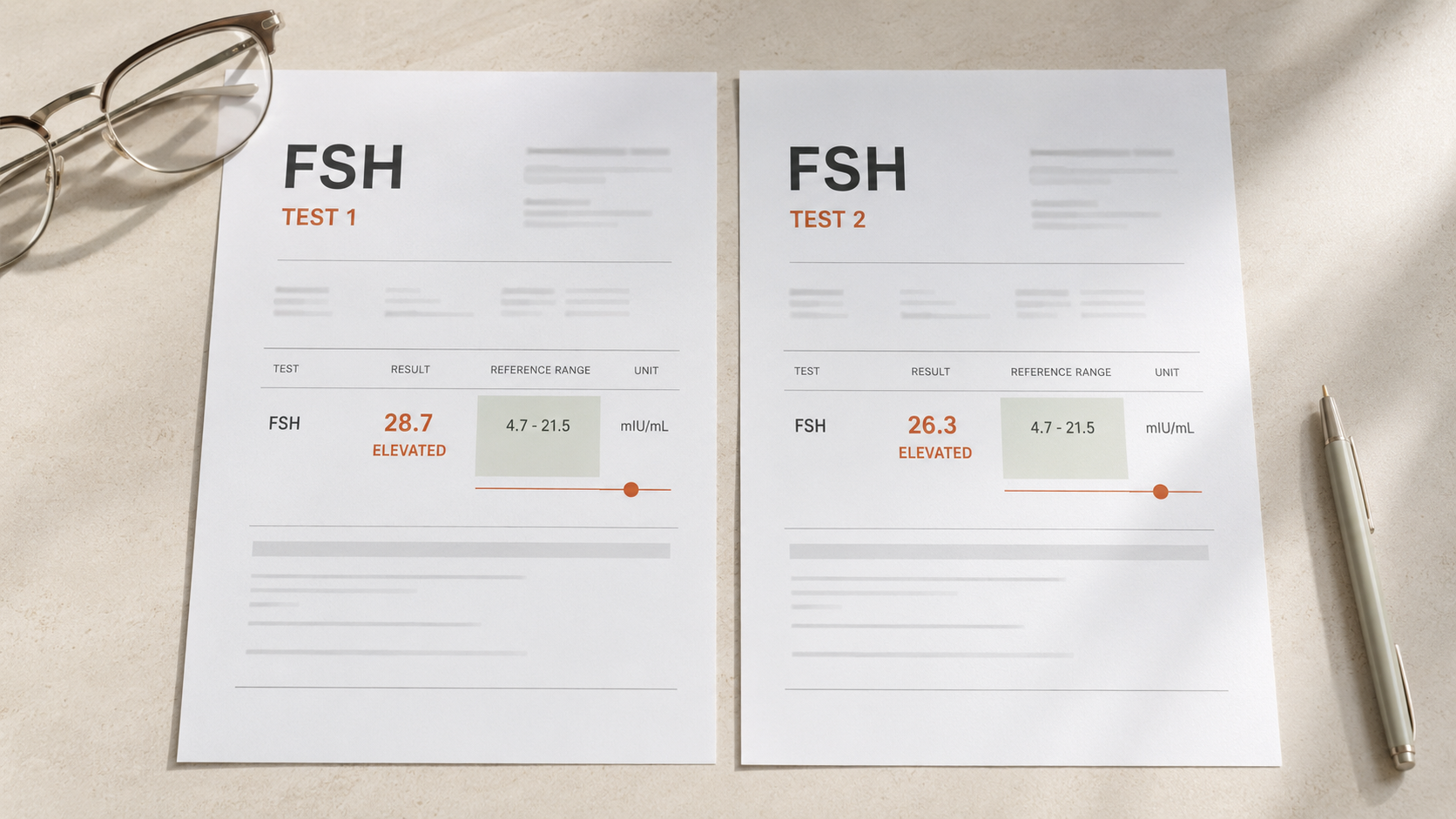
Diagnosis generally requires blood tests measuring follicle-stimulating hormone (FSH) levels on two separate occasions, at least four to six weeks apart, alongside a clinical history of irregular or absent periods. Persistently elevated FSH levels, in the menopausal range, support a diagnosis of POI. Additional tests may include assessment of anti-Müllerian hormone (AMH), a marker of ovarian reserve, and screening for genetic and autoimmune causes, particularly in younger women or those with a family history.
Given the significant implications of a POI diagnosis, both for fertility and long-term health, a thorough and unhurried diagnostic process matters. Women experiencing unexplained menstrual irregularity before the age of 40, especially alongside menopause-like symptoms, are encouraged to seek a proper evaluation rather than assuming the cause is stress or simply waiting for symptoms to resolve.
What a POI Diagnosis Means in Everyday Life
Receiving a diagnosis of POI, particularly at a young age, can be genuinely difficult to process. It often arrives unexpectedly, sometimes during investigations for unrelated concerns or fertility difficulties, and it raises questions that most women do not expect to confront in their twenties or thirties.
Fertility is often the most immediate concern. Because ovarian function in POI can be intermittent, spontaneous pregnancy remains possible for some women, which is both a source of hope and an important reason to continue using contraception if pregnancy is not desired. For women hoping to conceive, fertility specialists can discuss the range of options available, and timely referral makes a meaningful difference.
Long-term health is the other major consideration. Women with POI face an extended period of low oestrogen, often decades longer than women who reach menopause at a typical age, which significantly increases the cumulative risk of osteoporosis and cardiovascular disease if left unaddressed. For this reason, hormone therapy is generally recommended for women with POI, at least until the average age of natural menopause, unless there is a specific medical reason to avoid it. This is a different risk-benefit conversation than hormone therapy decisions made by women going through typical menopause, and it is worth discussing specifically with a healthcare provider familiar with POI.
Emotional support matters enormously here. A POI diagnosis can affect identity, relationships, and family planning in ways that menopause at a typical age does not. Connecting with healthcare providers who understand the condition, alongside community or peer support, can make a meaningful difference in navigating both the medical and emotional dimensions of this diagnosis.
Key Takeaways
- Premature ovarian insufficiency (POI) occurs when the ovaries stop functioning normally before age 40, affecting approximately 1 percent of women by that age.
- Unlike confirmed menopause, ovarian function in POI can be intermittent, meaning spontaneous ovulation and pregnancy remain possible for some women.
- Causes include genetic conditions, autoimmune disease, cancer treatments, and surgery, though many cases have no identifiable cause.
- Diagnosis requires elevated FSH levels on two occasions, at least four to six weeks apart, alongside a history of menstrual irregularity.
- Hormone therapy is generally recommended for women with POI to protect long-term bone and cardiovascular health, given the extended duration of low oestrogen.
At Emvera, we believe every woman deserves the knowledge and support to better understand, accept, and embrace menopause as a natural life transition. Through personalised symptom tracking, evidence-based education, a supportive community, and a curated marketplace of trusted wellness products, Emvera helps women navigate their menopause journey with greater clarity, control, and confidence.
While POI involves a gradual or intermittent decline in ovarian function, some women experience an abrupt and immediate transition to menopause through medical intervention. The next article, Surgical Menopause, explores what happens when both ovaries are surgically removed, how this differs from natural menopause, and what women need to know before and after this procedure.
References
- Coulam CB, Adamson SC, Annegers JF. Incidence of premature ovarian failure. Obstetrics and Gynecology.1986;67(4):604-606.
- Shelling AN. Premature ovarian failure. Reproduction. 2010;140(5):633-641.
- European Society of Human Reproduction and Embryology (ESHRE) Guideline Group on POI. ESHRE Guideline: management of women with premature ovarian insufficiency. Human Reproduction. 2016;31(5):926-937.
- The North American Menopause Society (NAMS). Menopause Practice: A Clinician’s Guide. 5th ed. Pepper Pike, OH: NAMS; 2014.